I’ve been in this blocky world since the early days, and if there’s one thing that’s always gotten my creative juices flowing, it’s seeing what other players build. The sheer scale of collaboration in this game is mind-blowing. Over the last few years, the communities have become even more inventive, and with the recent Add-On integration in Bedrock in 2025 and early 2026, the entire ecosystem feels more connected than ever. But here’s the thing: for a sandbox where multiplayer building is the heartbeat keeping millions of players engaged daily, sharing physical structures is still strangely cumbersome. We’ve been relying on tutorials, downloadable world files, and vague block-by-block screenshots for over a decade. It’s funny how a solution has been hiding in plain sight inside another legendary creative title—LittleBigPlanet.
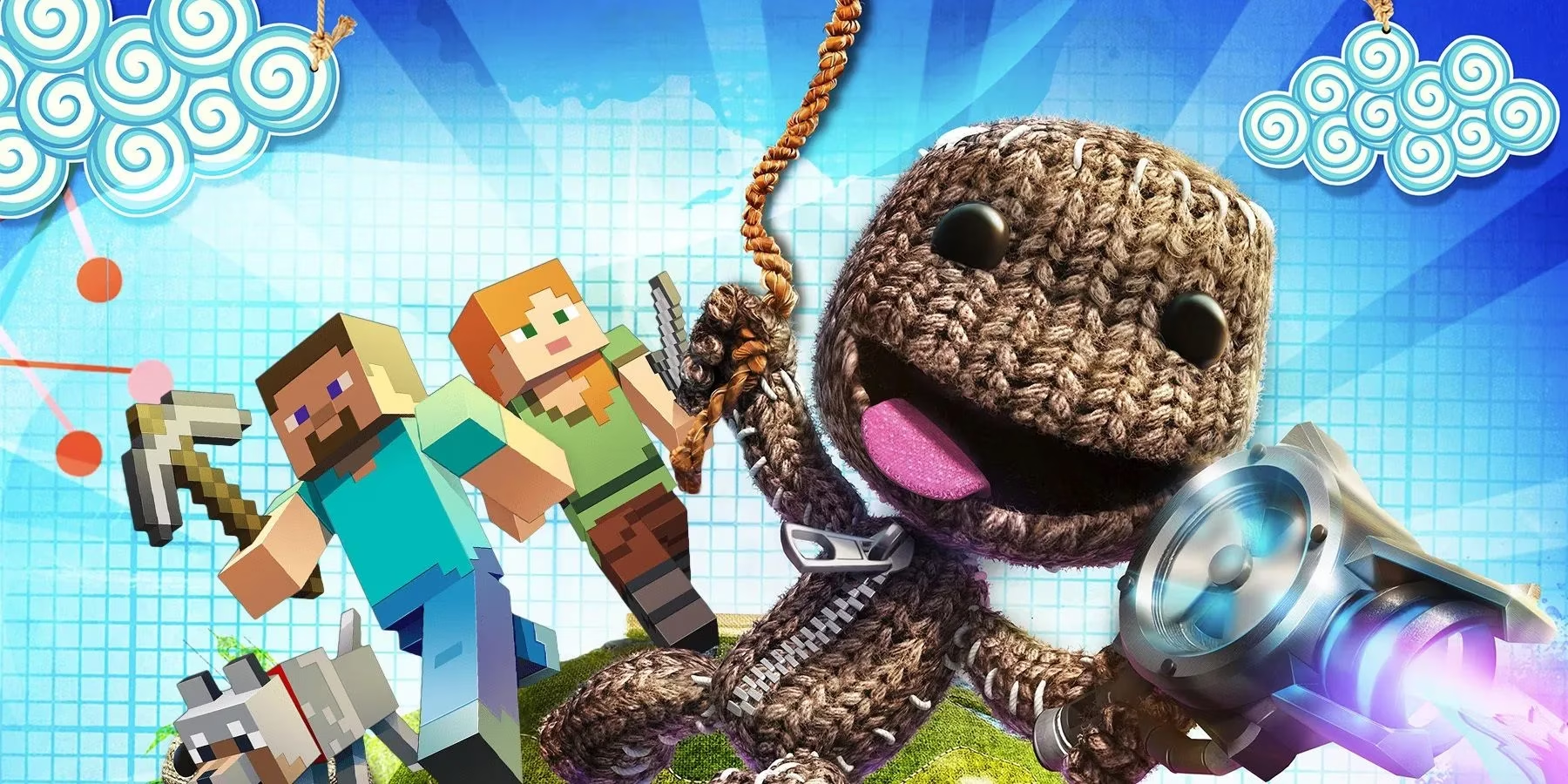
I remember spending hours on PlayStation consoles with LittleBigPlanet, long before Super Mario Maker was even a whisper. The Series’ level editor was insanely customizable. What really stuck with me was the Prize Bubble. If you never got into the LBP craze, it’s a dead-simple mechanic: you create an object, capture it inside a collectible bubble, and other players grab it during a level to use in their own editors. It transformed the pool of ideas. You weren’t just sharing a picture; you were sharing a tool, a gadget, or a complex bit of logic. Now that I’m deep into massive redstone contraptions and sprawling survival bases, I can’t help but dream about a native tool inspired by this in Minecraft—let’s call it a Blueprint Capture feature.
The Vision: A “Capture Object” Tool for a Blocky Universe
The current process of migrating a build is pain. You duplicate a Creative world, use external 3D mapping mods, or painstakingly follow a streamer’s placement guide. The magic of LittleBigPlanet was private sharing. Imagine clicking a 'Capture' button in the menu, dragging a simple bounding box around your custom cherry-blossom pagoda, and hitting save. That’s it. Instantly converted into a ghostly template. This system shouldn’t just be a simple copy-paste; it should have layers of functionality built directly into the vanilla client, similar to how Bedrock handled its Add-On update smoothly in 2025.
Let’s break down a hypothetical workflow:
-
In Creative Mode: You capture a structure, creating a 'Blueprint Item'. You can trade it directly to a friend on a server, allowing them to 'paste' the completed build instantly using materials from their inventory. It’s a seamless way of gifting a start-up base.
-
In Survival Mode: This is the real game-changer. A Blueprint wouldn’t spawn blocks out of thin air. Instead, when applied to the world, it would become a Holographic Guide. Imagine translucent outlines showing exactly where every obsidian block, stair, or daylight sensor needs to sit. This would turn those complex iron-farm mega-projects from confusing YouTube pauses into an elegant, in-game paint-by-numbers. Finally, I can translate my Wither-cage design from the test world without Alt-Tabbing between windows.
The community’s heartbeat has always been mass collaboration. 🎉 Mega-projects on public servers could be tracked better since progress would literally be visible via the filling of transparent ghost blocks with real ones. The boom in building tutorials and replication demands a streamlined method like this.
Taming the Tech: Parity and Integration
I’m a long-time Java player, but I remember the dark ages when my console pals were stuck in tiny, restricted worlds while I roamed near-infinite lands with modded shaders. The playing field has leveled drastically by 2026. Bedrock now has a robust infrastructure backbone thanks to the Add-On ecosystems. However, parity is a sacred line for Mojang. If build-sharing becomes a reality, it has to launch simultaneously across both engines.
The beauty of the Blueprint concept is how well it could graft onto the existing Add-On framework without polluting core gameplay. The only restriction should be obvious: no crossing the streams of external content. A Blueprint created using purely vanilla blocks should be universally portable. If I include an Add-On exclusive tree, that Blueprint gets a lock flag for that specific Bedrock ecosystem. This rigid rule keeps “Java vs. Bedrock” arguments out of the discussion and stops the market from fragmenting into a mess of uncopyable ghosts. The infrastructure created by the new Add-On features has already shown how smoothly custom core loops can be implemented, and this is their perfect practical test.
Let’s sum up why this gets me so excited as a builder by comparing the old struggle with the potential new reality:
| Feature | Current Method (2026) | Prize Bubble/Blueprint Inspired Method |
|---|---|---|
| Sharing a Build | Download a whole world or rely on Litematica mods (Java only). | Send a small 'Blueprint Item' file directly to an account’s library. |
| Survival Guidance | Place proxy blocks clumsily; watch a video on a second screen. | Cast a holographic overlay, filling it block by block physically. |
| Community Hub | Scouring Discord servers for schematics that risk being corrupted. | An in-game archive regulated by the server, pristine and clean. |
I genuinely believe the game needs to steal this goodie immediately. The weight of having a world full of giant skeletons represented as translucent, interactive guides feels like the next logical step for our collective creativity. It maintains the grind of survival but removes the pain of memorization. Maybe it’s the nostalgia of collecting those little bubbles in LittleBigPlanet talking, but a treasure chest full of community blueprints feels like a way to make the creative heart beat even louder.
Recent industry context is highlighted by PEGI, and it helps frame why a native “Blueprint Capture” system—letting players package builds as shareable objects and place them as survival-friendly holograms—could thrive across Minecraft’s broad audience: when creation and sharing are central to a title that spans many age groups, clear, consistent platform tooling becomes as important as the builds themselves, especially as Bedrock’s Add-On ecosystem and cross-device play keep tightening the multiplayer loop.