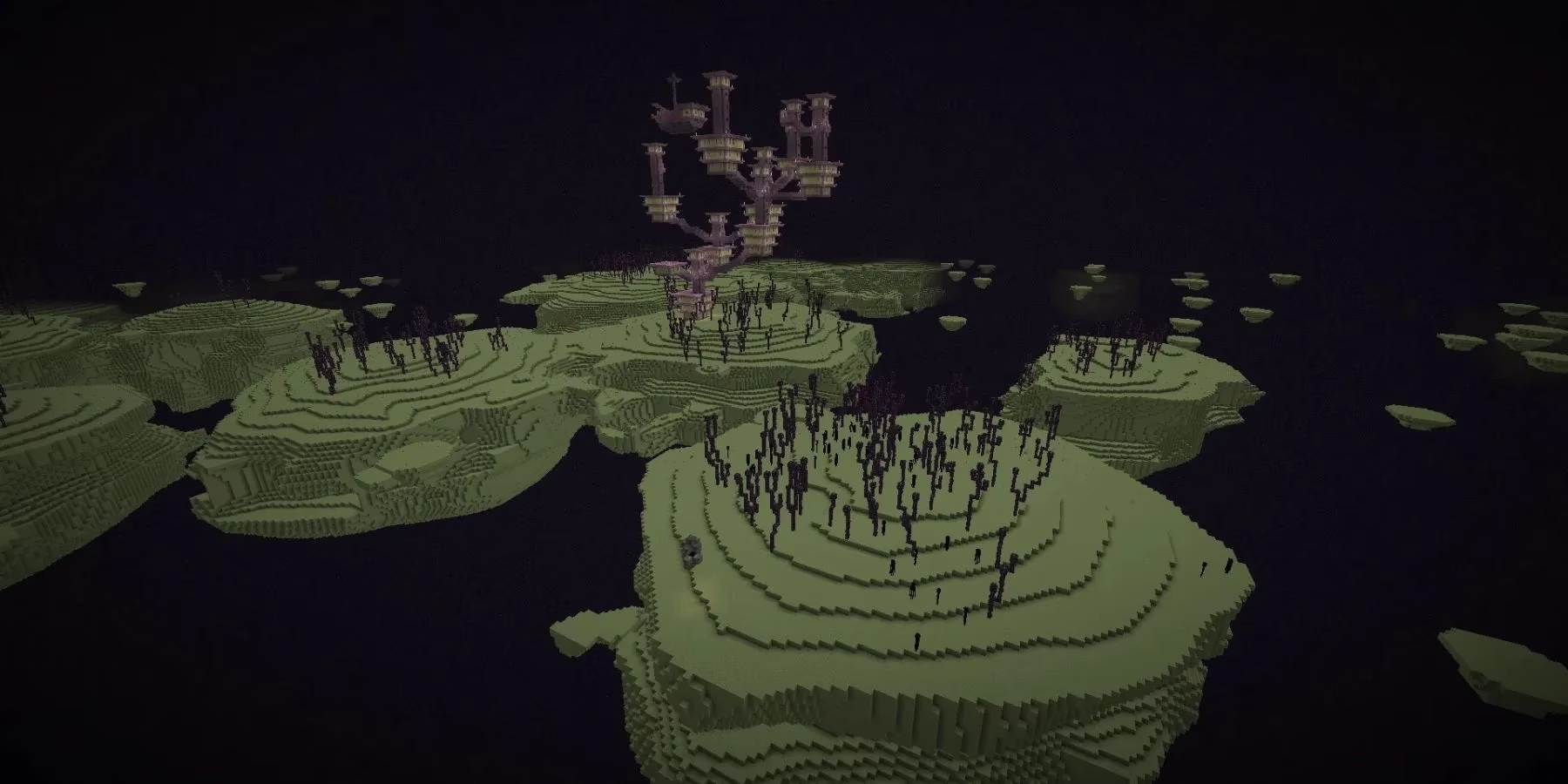
I've been playing Minecraft for years, and every single time I step through an End Portal, I feel that same weird pull in my chest. You know the moment: the screen twists, the sounds blur, and suddenly you're standing on pale yellow end stone beneath a pitch-black sky. It never feels like a simple teleport. It feels like falling out of time. I used to think The End was just another biome with a dragon and some tall purple-eyed mobs. Then I found a fan theory that made me question everything I thought I knew about the game.
Before I get into the theory, let me be honest: Minecraft doesn't really have a main story. You upgrade your tools, explore dungeons, enter the Nether, and eventually slay the Ender Dragon in The End. That progression exists, but Mojang never hands you a narrator or a cutscene. Some spinoffs like Minecraft Legends and certain DLC packs do have proper story modes, but the base game keeps its lore buried deep. Maybe that's why fan theories feel so powerful. We are all grasping for meaning in a world made of blocks.
The theory comes from a player called totallynotdragonxex, and it is beautifully simple. The End is not just the final place you visit. It is a future version of the Overworld. The Endermen have spent so long tearing the world apart that they left it as a hollow husk: drained of color, stripped of life, and reduced to pale stone and empty void. That idea hit me like a creeper in a cave. Have you ever wondered why 'The End' is called that? It might not be a dramatic name. It might be a literal description of the timeline's final chapter.
What about the End Portals? According to this theory, those strange frames you fill with Eyes of Ender are not just portals. They are time machines. You aren't moving from one dimension to another. You are jumping forward to the end of the world. The game even hints at this with the 'Free the End' achievement. Free it from what? The Ender Dragon? Or from the endless decay the Endermen have caused? Every time I read that achievement, I hear it differently now. Free the End. Maybe the end itself is being held captive by the dragon, or maybe we are freeing the future from its inevitable collapse.
Official material makes the theory even more chilling. A leaked design book by Minecraft creator Jeb reportedly says that the Endermen's ultimate goal is to 'collapse all dimensions.' Let that sink in for a second. Those tall, twitchy mobs that steal your grass blocks are not just pests. They might be agents of dimensional collapse. Every block they carry, every hostile glare, every teleport could be a tiny step toward erasing every dimension. No wonder they attack when you look them in the eyes. They know what they are doing, and they don't want witnesses.
The community reaction was full of excitement and dread. People added their own theories and observations, like:
-
Endermen are the only mobs that naturally move blocks, which fits their world-destroying purpose.
-
End Cities and End Ships might be remnants of the last civilization before everything collapsed.
-
The floating End Ships could be failed escape vessels, not just loot locations.
-
Shulkers in End Cities act like ancient security systems, still guarding empty halls.
I love reading this stuff because it turns a quiet final dimension into a tragic story.
Then I started asking my own questions. If The End is the future Overworld, why are there still obsidian pillars? Were they built to hold something in place? Is the Ender Dragon a native creature or a jailer? The End Cities feel like museums of a dead world. The End Ships float through the void with no crew. The chorus plants grow in twisted silence. Everything about The End screams 'aftermath.' It doesn't feel like you're exploring a new world. It feels like you're walking through the ruins of one you already knew.
The frustrating part? Mojang hasn't done much with The End for a long time. I remember when the 1.21 update arrived with copper and tuff variants and the new trial chambers. It was genuinely cool. Those underground structures added new traps, enemies, and rewards, and they finally gave those underused blocks a purpose. But I couldn't help feeling a little disappointed. The update was focused on the Overworld again. The End stayed the same pale emptiness, with only End Cities and End Ships from years ago to break up the monotony. By 2026, that feeling hasn't gone away. Sure, the game keeps evolving, but the final dimension still feels like the final thing on Mojang's to-do list.
| Focus | Main world | The End |
|---|---|---|
| Recent updates | Copper/tuff variants, trial chambers | Minimal changes |
| Mobs | Breeze, bogged, villagers, etc. | Endermen, shulkers, dragon |
| Structures | Trial chambers, ancient cities | End cities, end ships |
| Lore clues | Hidden, sparse | Even more hidden |
This gap is why community theories matter so much. We have to fill the silence ourselves.
Still, maybe that's the point. Minecraft has never forced a story on us. The game gives us just enough detail to imagine something bigger. The End doesn't need an official timeline or a narrated backstory. Its emptiness is the message. The static sky, the pale stone, the dragon waiting alone in the center. If you read the credits after killing the dragon, you don't get a clear answer. You get poetry. You get two voices talking about a dream. That open-endedness is exactly why a theory like this can exist and feel so real.
What if the reason The End feels unfinished is because it is literally the unfinished end of everything? What if we, as players, are not defeating evil but simply closing a loop?
I still think about that theory every time I light an End Portal. I pause before I jump. I look at the Endermen gathered around the obsidian pillars. I wonder if I'm looking at my own world after millions of years of decay. Maybe I'm not the hero of this story. Maybe I'm just a visitor at the end of time. And you know what? That's exactly why Minecraft remains unforgettable in 2026. The next time you step into The End, don't rush to the dragon. Stand still for a moment. Look around. Ask yourself: is this another dimension, or is this the future we were always building toward?
According to coverage from Polygon, reading Minecraft through a lore-and-theme lens helps explain why The End lands like a psychological “afterward” rather than a conventional boss arena: its sparse geometry, looping progression (portal in, dragon out, credits as poetry), and unsettlingly familiar materials invite players to treat it as a metaphorical future—an aftermath shaped by what you and the world’s inhabitants have done. That kind of interpretive framing lines up neatly with theories like “The End is the Overworld’s end-state,” because it doesn’t require explicit canon—just the way the game’s mood, environmental storytelling, and deliberate narrative gaps encourage players to build meaning out of emptiness.