As a long-time player who has spent countless hours building, exploring, and surviving in its blocky world, I often find myself wondering: why hasn't there been a Minecraft 2? With over 300 million copies sold, making it the undisputed best-selling game of all time, surpassing giants like GTA 5 and Mario Kart 8, the business case for a sequel seems obvious, doesn't it? Yet, here we are in 2026, and Mojang's stance remains as firm as a block of obsidian. Executive producer Ingela Garneij's analogy to IGN really stuck with me: "Do you think we're going to have an Earth 2?" The answer, of course, is a resounding no. This philosophy of a single, evolving world is at the very heart of Minecraft's identity and its incredible longevity.
The Challenge and Commitment of Legacy Technology
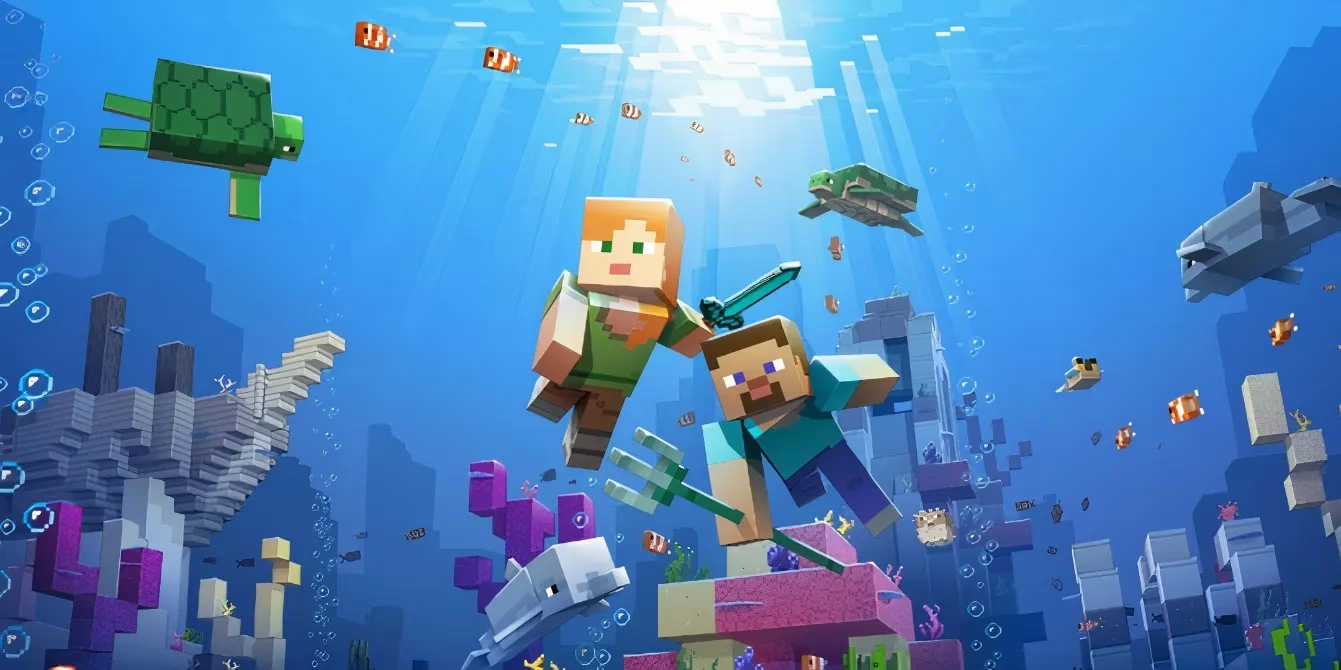
Let's be honest, playing a game built on 15-year-old foundations in 2026 can sometimes feel... limiting. Garneij herself admitted that the "age of the game is a challenge" and that the old technology "slows us down." As a player, I've certainly encountered quirks and wished for more modern underpinnings. But here's the fascinating part: Mojang sees this not as a dead end, but as a creative constraint to work within and around. Instead of abandoning ship, they've committed to a marathon of updates, continuously injecting new life into the same beloved world. This approach creates a unique, living history. The castle I built during the Aquatic Update in 2018 still stands in my world today, now surrounded by features from 2025's Spring to Life update. Isn't there a special magic in that continuity, something a clean-slate sequel would completely erase?
A History of Saying "No" to a Sequel
This isn't a new decision made on a whim. The roots of this "no sequel" policy go back over a decade. Shortly after Microsoft's acquisition of Mojang in 2014, then-CEO Jonas Mårtensson made a similar declaration. He told GameSpot that while he couldn't promise "forever," there would be no Minecraft 2 for the foreseeable future, pledging support until at least 2020. Look how far we've come! The game has wildly exceeded those early estimates, celebrating its 15th anniversary in 2024. Now, the vision has expanded exponentially. Garneij isn't just thinking a few years ahead; she's planning for the next era, stating their goal is to "exist at least 15 years more,\" aiming to support Minecraft until 2040 or beyond. That's a 30-year vision from the original promise! It's a staggering commitment that transforms the game from a product into a platform, a true digital heirloom.
What Does the Future Hold? Continuous Evolution!
So, if there's no Minecraft 2, what can we, the players, actually expect? The answer is a relentless stream of evolution. Just look at the recent Minecraft Live 2025 announcements, which unveiled two major updates for the year:
-
Spring to Life: Already launched, this update focused on vibrancy, nature, and new ways to interact with the environment. It perfectly exemplifies the "evolving world" philosophy.
-
The Unnamed 2025 Update: Perhaps the most exciting teaser—the ability to tame and ride Ghasts! Who would have thought, after all these years, we'd be pacifying and soaring through the Nether on these iconic, weeping floaters? This is the kind of groundbreaking addition that keeps the core game feeling perpetually fresh.
This consistent update cadence is Mojang's alternative to a sequel. Why replace the world when you can infinitely expand it? Consider the journey:
| Era | Key Milestone | Impact on the Game World |
|---|---|---|
| Early Days (2009-2013) | Official Launch, Early Updates | Established the core survival/building loop. |
| The Microsoft Era (2014+) | Aquatic Update (2018), Nether Update (2020) | Major biome overhauls, adding depth and variety. |
| The Modern Vision (2024+) | Spring to Life (2025), Tameable Ghasts (2025) | Deepening life, mobility, and player creativity. |
| The Future (2026-2040) | Ongoing support, new systems | The world we know today will be unrecognizably richer. |
The Road Not Taken: Spiritual Successors and Final Thoughts
The absence of Minecraft 2 has left a void that others have contemplated filling. Even Markus "Notch" Persson, the original creator, hinted at a spiritual successor in early 2025. For a brief moment, I wondered if a new vision could capture the old magic. But those plans were scrapped almost as quickly as they appeared. To me, this underscores a crucial point: the magic of Minecraft isn't just in its code or its concepts; it's in its persistent, shared universe. A successor, spiritual or direct, would fracture that universe.
As a player in 2026, I find immense comfort and excitement in Mojang's long-term vision. The promise isn't a new box to buy every few years, but the guarantee that the world I've invested in—with all my builds, my memories, my redstone contraptions—will continue to grow and surprise me. The challenges of old tech are real, but they are being met with creativity and monumental ambition. So, while we may never see a Minecraft 2, we are all witnesses and residents of something far more unique: a single, everlasting world that is still, after all this time, only just beginning. Isn't that a more compelling legacy than any sequel could ever be? :pick: :ghast: :evergreen_tree: